



A Swiss Heart
For AIM, Swiss Made isn’t simply something printed at six o’clock. It represents where and how our watches are made
Under Swiss law, a watch must meet specific requirements before it can carry the Swiss Made designation. Among other requirements, its movement must be Swiss, the movement must be cased in Switzerland, and final inspection must take place in Switzerland. At least 60% of the manufacturing costs of the completed watch must also be generated in Switzerland.
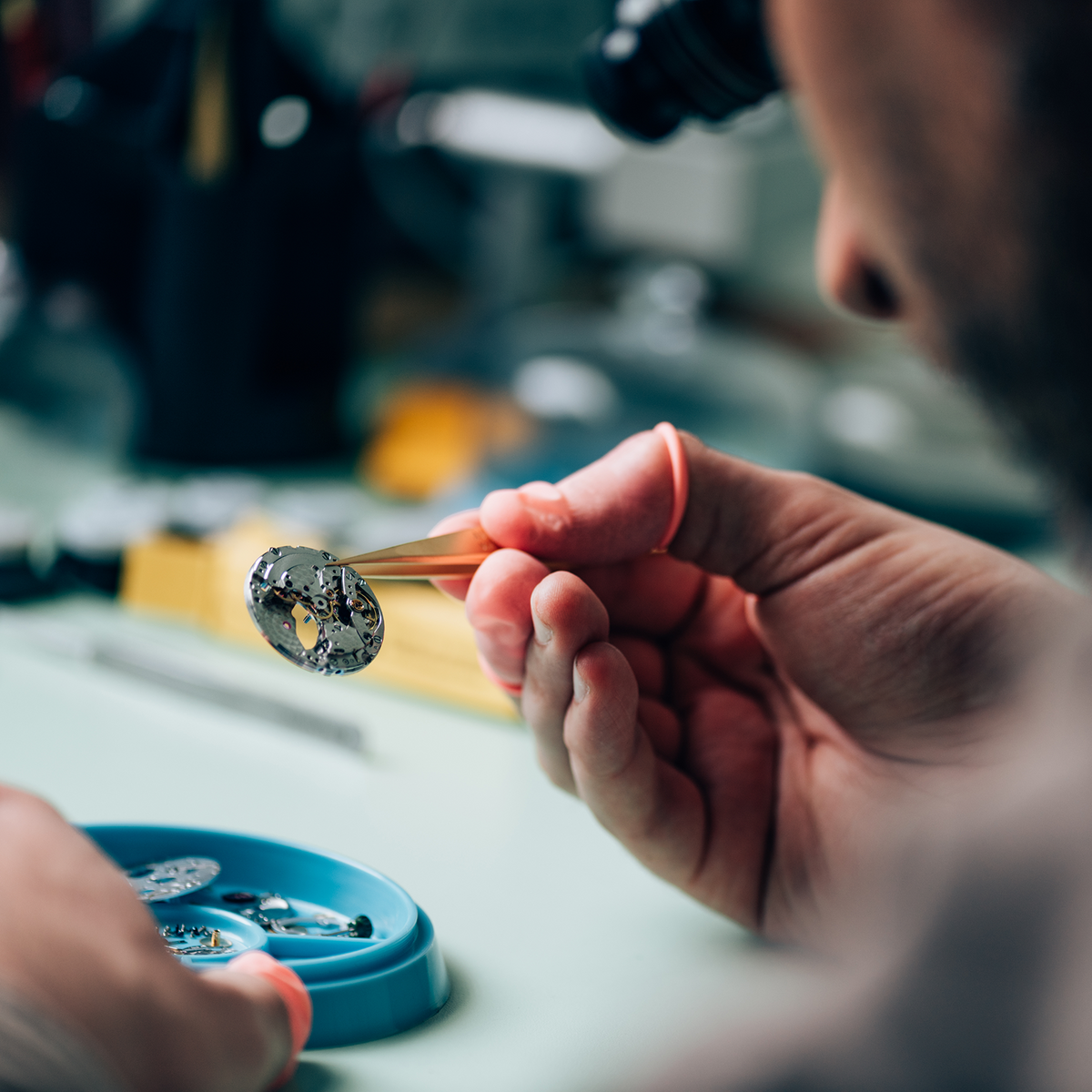
AIM watches use Swiss Sellita mechanical movements and are assembled, regulated and inspected in La Chaux-de-Fonds.
But for us, Swiss Made is only one layer of the story.
Precision underneath. Aviation history on the wrist.
The History of Watchmaking
For more than four centuries, Switzerland has been at the heart of watchmaking. What began as a specialist craft developed into an industry renowned around the world for precision, mechanical ingenuity and craftsmanship.
The story begins in 16th-century Geneva. During the Reformation, restrictions were placed on wearing decorative jewellery, encouraging many of the city’s highly skilled goldsmiths and craftsmen to turn their attention to watches. The craft grew rapidly and, by 1601, Geneva’s watchmakers had established their own guild.
From Geneva to the Jura
Over time, watchmaking spread from Geneva northwards into the Jura Mountains, particularly to Le Locle and La Chaux-de-Fonds.
The long Jura winters helped create an unusual ecosystem of specialist craftsmen. Individual families and workshops became skilled in producing particular components, movements, wheels, springs, cases, dials and hands, which could then be brought together to create a complete watch.
It was the beginning of a tradition of specialist knowledge that continues in the region today.
By the 18th and 19th centuries, watchmaking had become so central to La Chaux-de-Fonds that the town itself developed around the industry. Workshops were designed to capture natural light, while homes, factories and streets evolved around the needs of watchmakers.
The relationship between the town and its industry is so significant that La Chaux-de-Fonds and neighbouring Le Locle became a UNESCO World Heritage Site in 2009, recognised for their unique watchmaking urban landscape.
Precision, Craft and Innovation
During the 19th and 20th centuries, traditional workshops gradually evolved alongside larger manufacturers. New machinery allowed components to be made with ever greater consistency, while generations of watchmakers continued to develop increasingly sophisticated mechanical movements.
Switzerland became known not simply for making watches, but for the pursuit of precision and mechanical refinement.
Chronographs, automatic movements, calendars, moon phases and increasingly complex mechanisms demonstrated something that remains fundamental to mechanical watchmaking today: a watch can be both an instrument and an object of craftsmanship.
A Tradition That Continues
Today, Switzerland remains one of the world’s great centres of watchmaking, combining centuries of accumulated knowledge with modern engineering, manufacturing and materials.
In 2020, UNESCO recognised the craftsmanship of mechanical watchmaking and art mechanics of the Swiss-French Jura Arc as part of the Intangible Cultural Heritage of Humanity.
It is here that AIM watches are produced and assembled.
For us, that connection is important. AIM brings together two traditions of mechanical engineering: Swiss watchmaking and aviation. Swiss mechanical movements and watchmaking craftsmanship provide the foundation, while genuine aviation history gives each collection its individual story.
Aircraft that once crossed oceans and connected cities can live again in a very different mechanical form, transformed into something designed to be worn for generations.
Swiss Made is therefore more than two words on an AIM dial.